Research
Transformations from memory to action in the prefrontal and motor cortices
Adithya Narayan Chandrasekaran, Megan McDonnell#, Chris Ki#, Byron Yu, Aaron Batista*, Steve Chase* Matthew Smith*
SFN 2025, Population doctrine workshop 2025
Decomposing behavioral variability into perceptual, decisional, and motor components
Adithya Narayan Chandrasekaran, Megan McDonnell, Chris Ki, Adam Smoulder, Byron Yu*, Aaron Batista*, Matthew Smith*, Steve Chase*.
Cosyne 2024, SFN 2024, Simco 2024, CMU Forum on Biomedical Engineering 2023 (award for best presentation), NHPGH Pittsburgh 2023
Dissociable components of attention exhibit distinct neuronal signatures in primate visual cortex.
Adithya Narayan Chandrasekaran*,Ayesha Vermani*, Priyanka Gupta, Nicholas Steinmetz, Tirin Moore, Devarajan Sridharan. Science Advances 2024
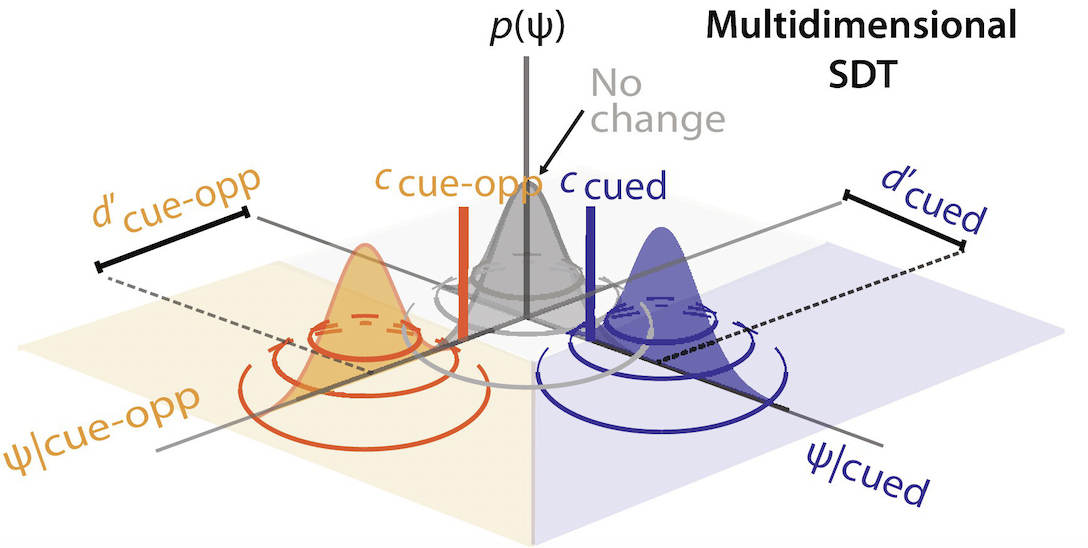
Abstract: Attention can be deployed in multiple forms and facilitates behavior by influencing perceptual sensitivity and choice bias. Attention is also associated with a myriad of changes in sensory neural activity. Yet, the relationship between the behavioral components of attention and the accompanying changes in neural activity remains largely unresolved. We examined this relationship by quantifying sensitivity and bias in monkeys performing a task that dissociated eye movement responses from the focus of covert attention. Unexpectedly, bias, not sensitivity, increased at the focus of covert attention, whereas sensitivity increased at the location of planned eye movements. Furthermore, neuronal activity within visual area V4 varied robustly with bias, but not sensitivity, at the focus of covert attention. In contrast, correlated variability between neuronal pairs was lowest at the location of planned eye movements, and varied with sensitivity, but not bias. Thus, dissociable behavioral components of attention exhibit distinct neuronal signatures within the visual cortex.
Memory of relative magnitude judgements informs absolute identification
Adithya Narayan Chandrasekaran, Narayanan Srinivasan, Nisheeth Srivastava. Proceedings of International Conference on Cognitive Modelling 2019
Abstract: We characterize difficulties with both absolute and relative accounts of magnitude representation in the absolute identification paradigm and present a resolution for these difficulties. We postulate that people store neither long-term internal referents for stimuli nor operate simply using binary comparisons of size between successive stimuli. Rather, they obtain probabilistic judgments of size differences between successive stimuli and encode these for future use, within the course of identification trials. We set up a Bayesian ideal observer model
for the absolute identification task using this memory-based representation of magnitude and propose a memory-sampling algorithm for solving it. Simulations suggest that this model captures complex human behavior patterns in absolute identification. Specifically, it reproduces empirically documented crossover effects, practice effects, effects from the use of overlapping stimuli and stimuli with uneven spacing.